Monterey Bay Aquarium, Monterey, California
A Bird Tending Its Feathers
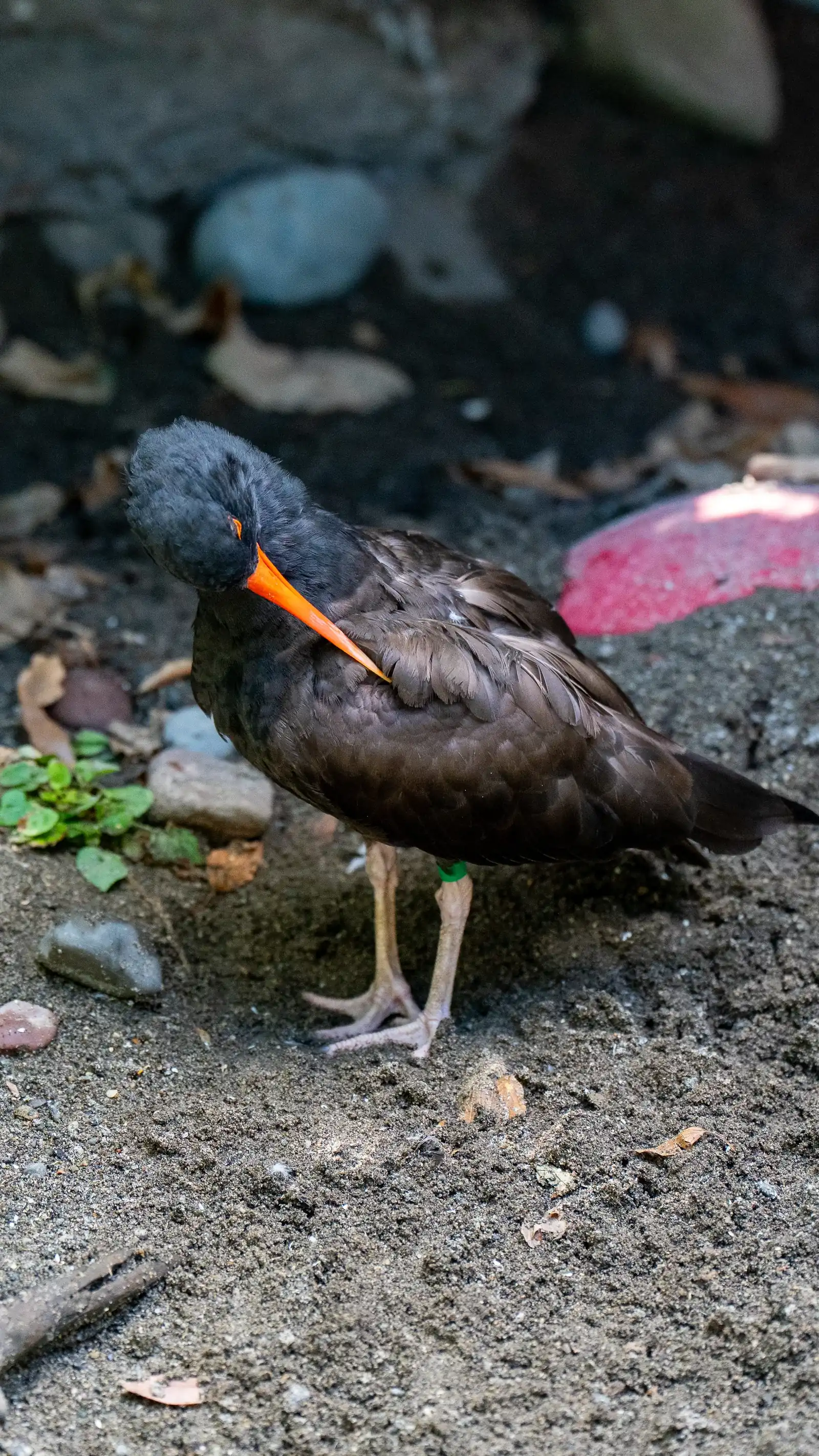
At the Monterey Bay Aquarium, a black oystercatcher pauses to preen, bright orange bill tucked against dark plumage.
There's a version of this photograph where the bird looks straight at the camera, alert and posed. This isn't that version, and I think it's better for it.
The oystercatcher stands in the middle of the frame, its body turned to the right, its head turned back and down, the long orange bill tucked against its side as it preens. Its plumage is a deep, soft brown-black, with the edges of the wing feathers catching a faint sheen. The head feathers are slightly ruffled. The eye has a thin orange ring around it, a small detail you only notice up close. Its legs are pale pink, and on one of them, a green band.
That band is a reminder that this bird lives at the aquarium, in a managed habitat. I want to be clear about that. I didn't encounter it on a wild rocky coastline. But the aquarium's shorebird habitat gives you a chance to watch these birds at close range and see behaviour like this, which in the wild usually happens at a distance.
The ground around the bird is dark, sandy soil scattered with small pebbles, dry leaves and a few green plants at the left. Behind it, softer and out of focus, larger rounded stones and a patch of bright pink at the right.
I composed vertically, with the bird in the middle third and lots of ground below it. The bird's body forms a gentle curve from its tucked head down to its tail, and the bright orange bill cuts diagonally across that curve. That bill is the most vivid colour in the frame, and it pulls the eye straight to the bird's head.
Preening is a quiet, everyday behaviour. Birds spend a lot of time maintaining their feathers. Catching that moment, rather than a stiff pose, makes the picture feel more like observation and less like a portrait.
From the bag
Sony A7R III · Sony FE 70-200mm F2.8 GM OSS II · 200mm · 1/800s · f/3.5 · ISO 2500
At 200mm, I could fill the frame with the bird from the visitor area. f/3.5 gives shallow depth of field, so the bird stands out against a soft background while its head and bill stay sharp. The habitat was shaded, so ISO 2500 was needed to keep the shutter at 1/800s, which freezes the quick movements of preening. The A7R III handles ISO 2500 well, and the fine feather detail survives.