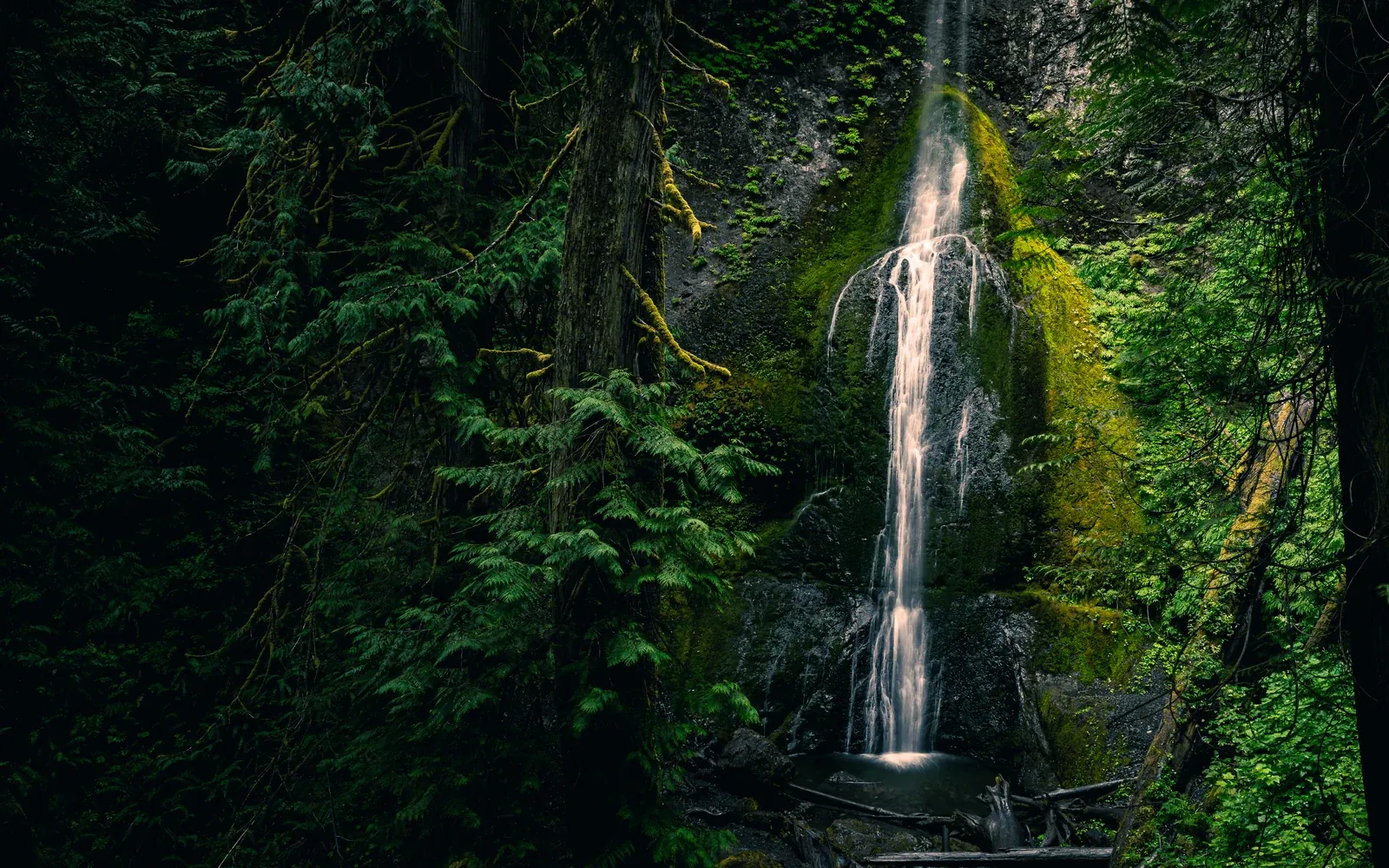
Marymere Falls, Olympic National Park, Washington
A Thin Line of Light in a Green Room
A short trail near Lake Crescent, an old forest, and a waterfall that asks you to lower your voice.
You hear Marymere Falls before you see it, but only just. It isn't a thundering waterfall. It's a steady, narrow pour that sounds more like rain on a roof than a river falling off a cliff, and the forest around it absorbs most of the noise anyway.
The walk in is short, a trail through the woods near Lake Crescent, the kind of path that feels effortless until you realise you've stopped looking at your feet entirely. Everything is green. The trunks are wrapped in moss. Ferns spill over the edges of the trail. Branches hang with strands of moss that catch the light like old lace. Coming from Phoenix, where green is something you water deliberately, a forest like this feels almost excessive, like the landscape has too much of everything and doesn't know where to put it.
The falls appear at the end, through a gap in the trees: a single silver line dropping down a dark cliff face, split in a few places where it hits ledges and fans out before gathering itself again. The rock behind it is slick and black, but the edges glow a bright, almost electric yellow-green where moss has taken hold in the spray. At the bottom, the water settles into a small dark pool, with fallen logs lying across the stream below it.
What struck me was how little light there was. Under the canopy, the forest was deep in shadow, with only a few patches catching what came through the leaves. The waterfall, though, seemed to carry its own light. White water reflects everything, so even in that dim green room it stood out as the brightest thing in sight.
That became the photograph. I didn't want to brighten the whole forest and flatten it into an even green wall. I wanted the darkness on the left side of the frame to stay dark: the trunk, the ferns, the hanging moss, a dense, almost black frame that you look through to reach the falls. The waterfall would sit to the right of centre, lit and smooth, with the mossy cliff glowing around it.
I worked slowly. Footing near the viewing area is damp, and the forest has a way of making you move gently anyway. I adjusted the composition a few times to get a fern frond into the lower left, to keep a tree trunk running up the frame as a dark vertical against the bright vertical of the water. Two lines, one shadow, one light.
There's a reason so many people walk this trail. It's easy to reach and it's beautiful. But standing there, I felt like the place still belonged more to the moss than to us. The waterfall has been drawing that same line down that same rock for a long time. I just happened to be there with a camera for three-fifths of a second of it.
From the bag
Sony A7R III · Sony FE 16-35mm F2.8 GM II · 21mm · 3/5s · f/10 · ISO 100
Waterfalls in deep shade are a gift for slower shutter speeds. At 3/5 of a second, the falls turn from individual droplets into a smooth ribbon, but the exposure isn't so long that the water loses all its texture and becomes a blank white stripe. f/10 kept everything from the ferns in the foreground to the cliff behind the falls in focus, and ISO 100 kept the shadows clean, which matters in a frame where so much of the image is dark green and near-black. At 21mm I had enough width to include the forest around the falls as a frame, without making the waterfall itself look tiny. Anything under a second needs a steady support, and I exposed for the bright water first, letting the forest fall into shadow rather than lifting it.