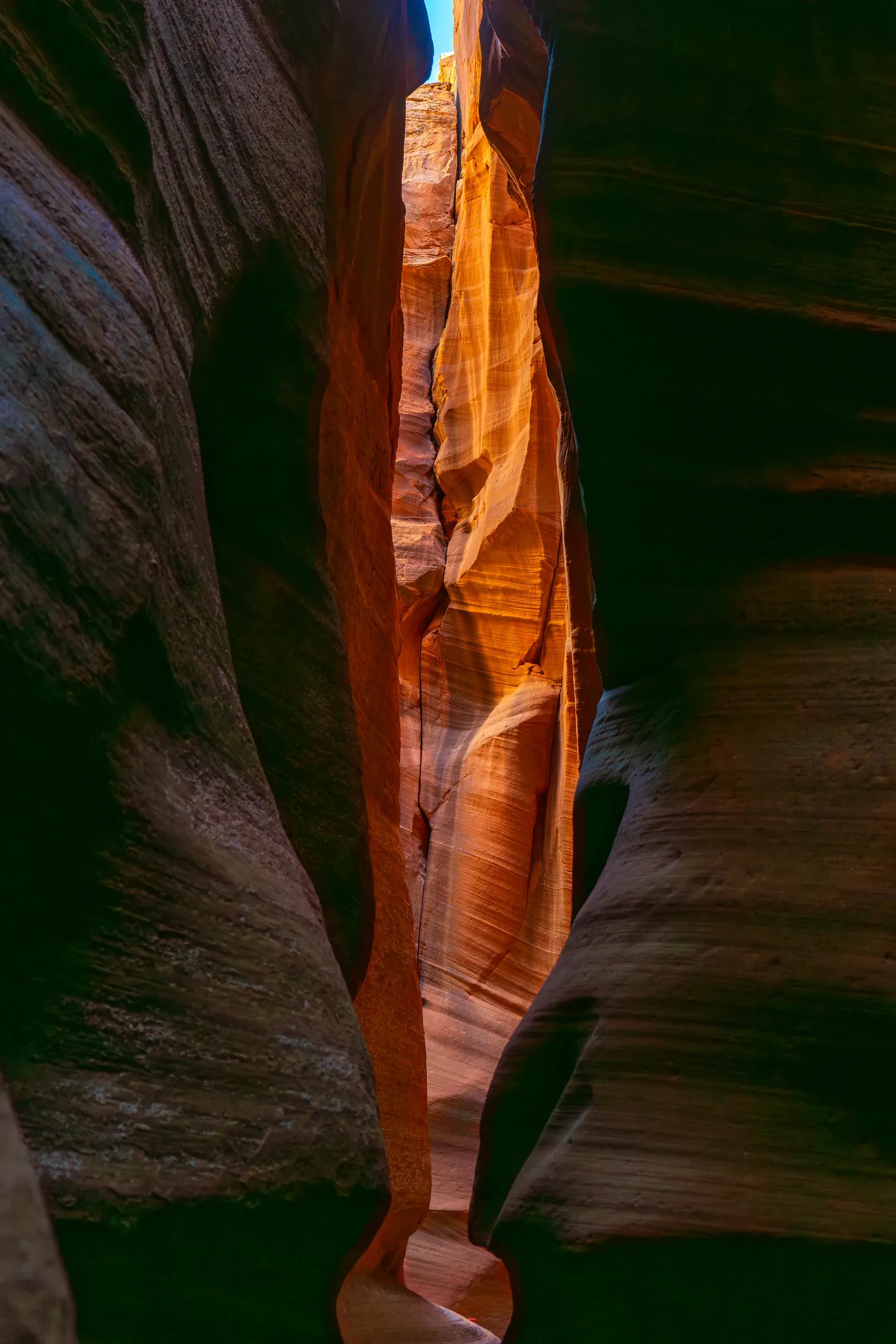
Lower Antelope Canyon, Page, Arizona
Inside the Stone
In Lower Antelope Canyon, the light arrives secondhand, and it's better for it.
From the surface, there's almost nothing to see. A crack in the sandstone, a seam in a flat, sunburned landscape outside Page. If you didn't know it was there, you could walk right past it. Then you go down the stairs, squeeze into the gap, and the whole world changes colour.
Lower Antelope Canyon is on Navajo land, and you visit it with a Navajo guide. I'm grateful for that. The guide knows the canyon in a way no visitor can: where the light falls at which hour, how floods have reshaped the passages, which turns are worth pausing at. It also sets the pace. You move through the canyon as part of a group, steadily, and you learn to work fast and see quickly. There's no setting up and waiting for an hour here.
The canyon is narrow. In places, you can touch both walls at once. The sandstone curves and folds in long, smooth waves, carved by water rushing through during flash floods and by wind in between. Every surface is layered with fine lines, like the grain in wood or the rings in a tree, records of the sand that settled here long before it became stone.
And then there's the light. Very little of it reaches the floor directly. Sunlight comes in through the slit far overhead and bounces from wall to wall on its way down, and every bounce warms it. By the time it reaches you, it's no longer sunlight in any ordinary sense. It's orange, amber, rose, gold, depending on how many times it has been reflected and off which stone.
The frame on my homepage is about that bounce. I found a spot where two dark walls closed in on the foreground, rough and shadowed, almost black on the edges. Between them, a deep corridor opened up, and the far walls were glowing, caught by light that had already ricocheted down through the canyon. At the very top, a thin blade of blue sky. That blue mattered. It's the only reminder in the frame that there's an outside world, and that all this colour began as ordinary daylight.
I live in Phoenix, so the desert isn't exotic to me. I know the heat, the space, the long views. Slot canyons are the opposite of all of that. They're cool, enclosed, intimate. They take everything I associate with the desert and fold it inward. Standing at the bottom, looking up through that seam of sky, I felt like I was inside the terrain rather than looking at it.
The group moved on. I took one more look up, then followed.
From the bag
Sony A7R III · Sony FE 16-35mm F2.8 GM II · 34mm · 1/80s · f/2.8 · ISO 100
Slot canyons are dark, and they're also extremely high-contrast: a sliver of bright sky against walls in deep shadow. I shot this handheld, so I needed a shutter speed fast enough to stay sharp while moving with the group. 1/80s at 34mm does that comfortably. Opening the 16-35mm all the way to f/2.8 let in enough light to make that possible at ISO 100, which kept the shadows in the dark foreground walls as clean as possible, so I could lift them later without noise. At 34mm, near the long end of the lens, I could isolate the glowing corridor instead of including everything around me; at 16mm, the canyon tends to feel cluttered. I exposed to protect the bright walls and the blue sky, and let the near walls fall dark to frame the light.