Negril, Jamaica
The Lighthouse at the End of the Island
Late sun on Jamaica's West End, and a set of camera settings I wouldn't recommend, but that worked.
Negril's West End doesn't have beaches. It has cliffs. After the long sweep of sand on the other side of town, the coastline here turns to hard, pitted limestone: grey and gold, full of holes and ledges, dropping straight into clear water. And standing at the end of it, near the westernmost point of Jamaica, is the lighthouse.
I came to it in the late afternoon, when the sun had dropped low enough to turn warm but hadn't yet gone into its sunset show. That was the light I wanted. Sunset on the West End is famous, and deserves to be, but sunset light is mostly about the sky. I wanted light that would land on the lighthouse itself.
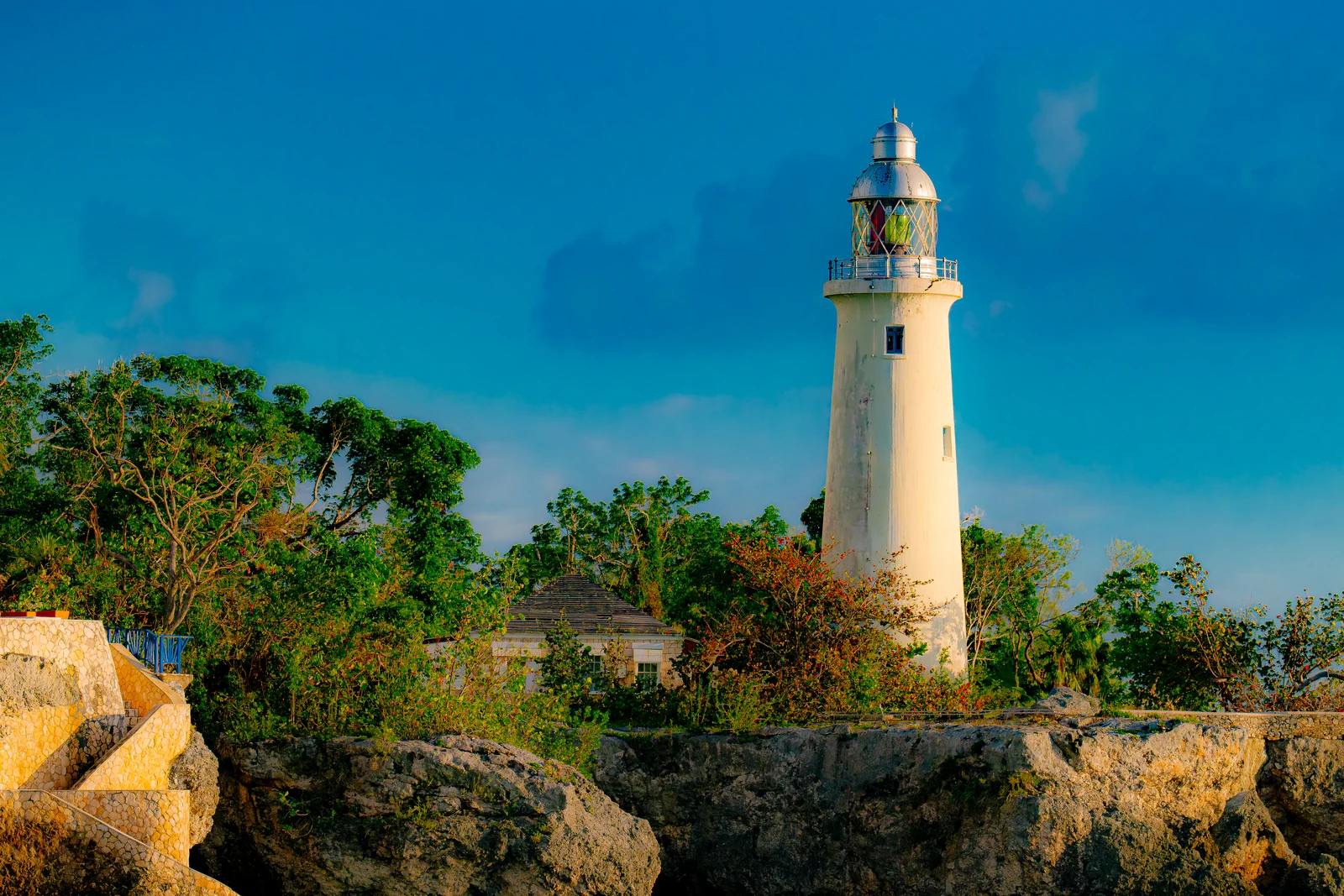
It did. The tower is white, and the low sun painted it a soft cream on one side, with long shadows sliding down its curve. The lantern room on top caught the light in its glass, flashes of red and green from inside. Behind the tower, the sky had gone a deep, saturated blue with only a few faint clouds. In front, a band of tropical trees ran along the cliff edge, some green, some touched with orange and red, all lit from the side. A small building with a pyramid-shaped roof sat tucked into the trees at the lighthouse's base, and on the left, a set of stone steps and walls climbed the rocks.
It was a scene that wanted to be photographed tight. From a distance, the lighthouse is one element among many: the road, the cliffs, the sea, the people. Through a long lens, it becomes a portrait. I pulled in until the frame held only the essentials: the tower, the trees, the cliff, the sky. The limestone stretched across the bottom of the frame like a pedestal.
I like that the lighthouse doesn't stand alone in this picture. The trees crowd around it. The rocks in front are rough and uneven. The stone steps on the left feel like the beginning of a path you could take. It reads less like a landmark postcard and more like a place someone lives with, which, on an island, a lighthouse is.
There's a calm to this kind of light that's hard to explain. The island had been bright and hot all day, the kind of overhead sun that flattens everything. Then, for maybe half an hour, everything picked up texture and colour, and the whole coastline seemed to exhale. The lighthouse just stood in it, glowing.
Then the sun went down into the sea, the sky turned to fire, and everyone along the cliffs turned to face west. I did too. But the frame I keep coming back to is this one, from just before.
From the bag
Sony A7R III · Sony FE 70-200mm F2.8 GM OSS II · 164mm · 1/8000s · f/4.5 · ISO 3200
These numbers look strange, and I'll be honest about that. On a bright afternoon, ISO 3200 is far more sensitivity than the scene needed; the camera answered by pushing the shutter all the way to 1/8000s, the fastest the A7R III's mechanical shutter goes. It's not the combination I'd teach anyone to choose. At base ISO, the same exposure would have come in around 1/250s, which is still more than enough to freeze a scene that isn't moving. The reason it still works is that the A7R III handles ISO 3200 well in good light, and the scene was well exposed, so the noise stayed manageable once the file was processed. The lesson I take from it: check your ISO when the light changes. The part I'd repeat exactly is the focal length. At 164mm, the telephoto compressed the trees, the tower, and the cliff into one tight, layered portrait, and f/4.5 kept the lighthouse and the trees around it sharp.