Mount Rainier National Park, Washington
The Mountain Behind the Falls
At Mount Rainier, a small cascade, a wooden footbridge, and the glaciers half hidden in cloud.
Myrtle Falls is not a big waterfall. Its drama comes from what's behind it.
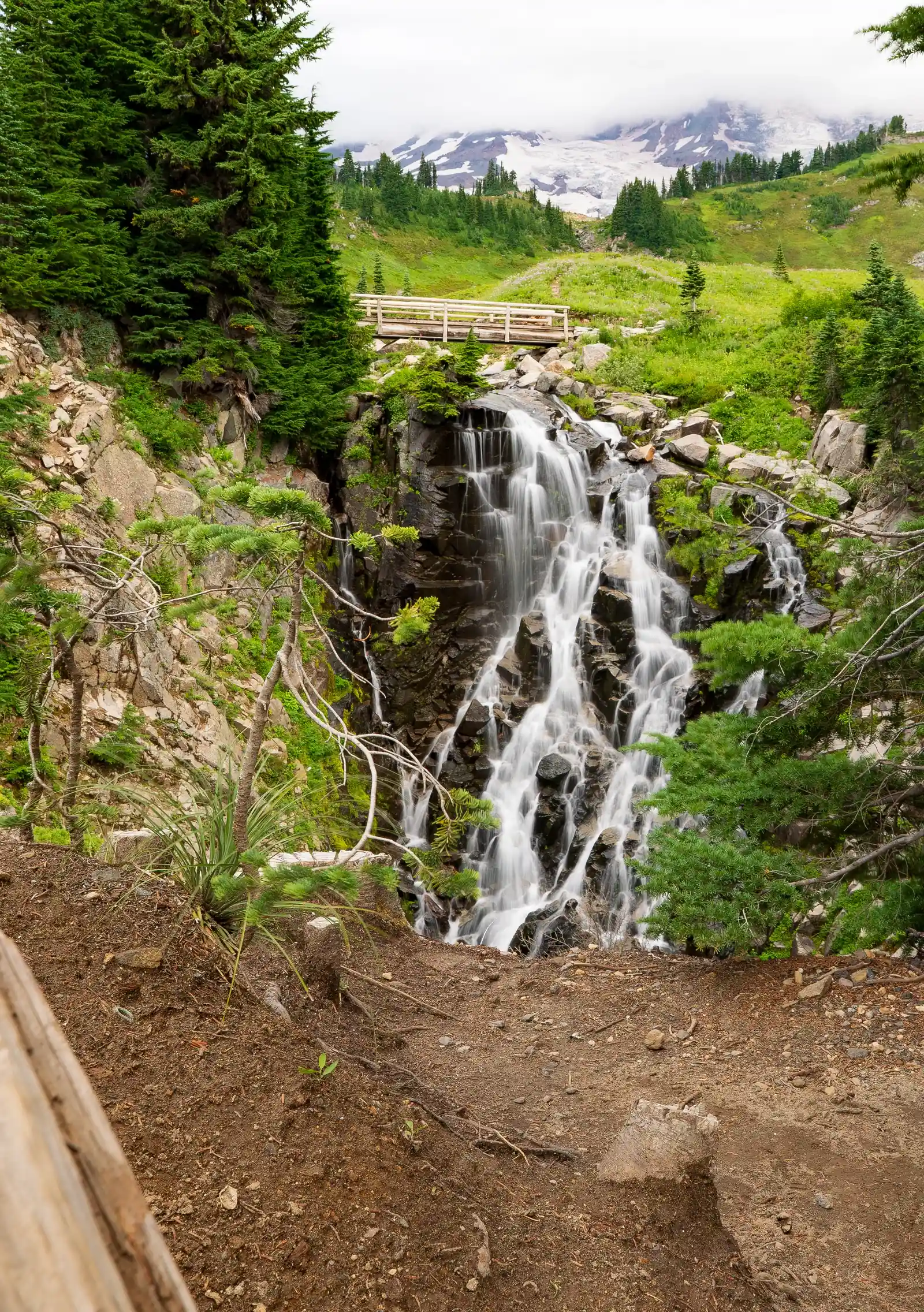
The falls fill the middle of the frame, a series of white cascades spilling down a dark, rocky chute. The water splits into several streams, tumbling over ledges and boulders, and at the bottom it disappears into a gap in the rocks. The rocks are dark grey and black, splashed with patches of bright green moss and plants.
Above the falls, a wooden footbridge crosses the stream, its railings pale against the green. Beyond the bridge, a meadow of bright green grass and plants climbs a gentle slope, dotted with dark green conifers. And beyond that, at the top of the frame, the mountain: a broad sweep of snow and glacier, streaked with dark rock, its upper slopes and summit lost in cloud.
The clouds were heavy on the mountain, and the summit stayed hidden behind its own weather. What's visible is still enough to tell you where you are: the white glaciers, enormous even half covered, looming over the meadow.
The foreground is the trail. A dusty path curves along the bottom of the frame, with a weathered wooden rail at the lower left. On the left side, a steep bank of rocks and small trees. On the right, conifer branches reach into the frame.
I composed vertically, with the falls in the centre and the mountain at the top. The trail, the falls, the bridge and the glaciers stack up in a line, each one leading to the next. Your eye follows the water up to the bridge, the bridge up to the meadow, and the meadow up to the mountain.
It's a classic view, and a popular one. I don't mind that. Some places are popular because they're beautiful, and this one earns it.
From the bag
Sony A7R III · Sony FE 16-35mm F2.8 GM II · 16mm · 1/3s · f/10 · ISO 125
At 16mm, the widest end of the 16-35mm, I could fit the trail at my feet, the falls, the bridge and the mountain into a single frame. f/10 keeps all of those layers in focus. 1/3s blurs the cascades into soft white streams while keeping some texture in the water. At ISO 125, the shadows on the rocks stay clean. An exposure that long needs a steady support.