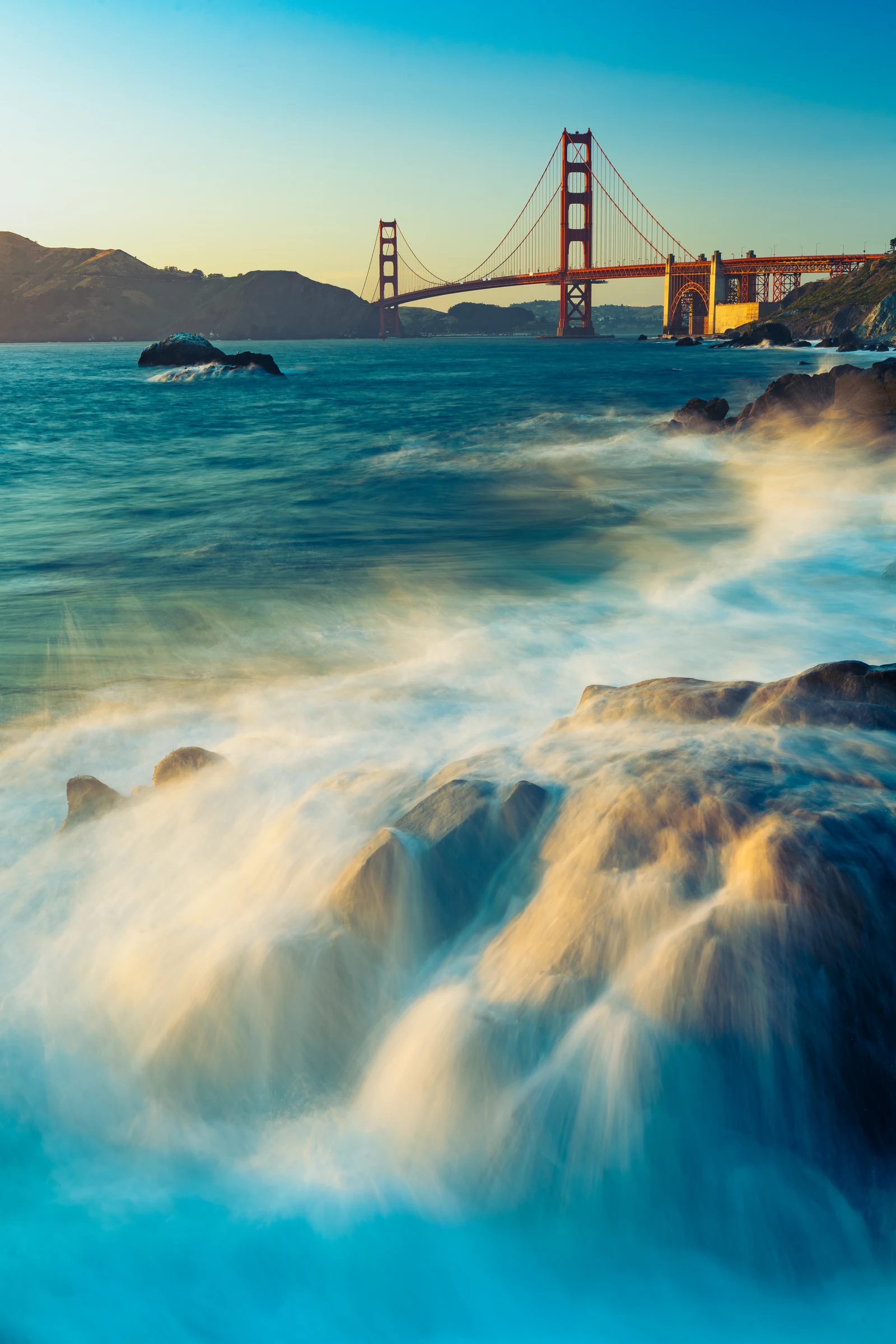
Golden Gate Bridge, San Francisco
Two and a Half Seconds at the Edge of the City
The most photographed bridge in America, and the rock at my feet that wanted all the attention.
Everyone comes for the bridge. I did too. But the thing I remember most about this evening isn't the red steel. It's a slab of rock, low and dark and slick, sitting on the San Francisco side of the strait where the Pacific starts pushing into the bay.
The light that evening came in low and sideways, the kind of late sun that turns the towers a warmer orange than their paint and lays gold across anything wet. Out past the rocks the water was a deep teal. Across the strait the Marin Headlands had gone soft and brown in the haze. The bridge itself was doing what it always does: standing there, perfectly composed, waiting for its portrait.
The problem with the Golden Gate is that it's already been photographed in every way you can imagine. You don't get a new picture by finding a new angle on the bridge. You get one by finding something in the foreground worth caring about, and then letting the bridge be the setting rather than the subject.
So I watched the waves.
They came in sets. A few small ones would lap at the rocks without much interest, then a bigger one would arrive, climb the face of the slab, and pour back down in sheets. Each time the water drained off, it found the same channels in the stone, the same seams and ledges. It was almost choreographed. If I could hold the shutter open across one of those big pours, the camera would draw the path the water took instead of freezing a single splash.
I set up low, close enough that the spray occasionally reached the front of the lens, and framed the rock to fill the bottom half of a vertical frame. The bridge sat high and small in the upper third, south tower anchoring the composition, the arch at the city end catching the last direct sun. Then it was just timing. Wait for a quiet set. Wipe the front element. Wait for the big one. Press the shutter as the wave hits, and let it run.
Most attempts were wrong in one way or another: too early and the water barely moved, too late and the rock went dull and flat. The frame on my homepage is the one where the wave crested over the stone just as the exposure began, and drained back across it as the exposure ended. The water turned to mist and ribbons, wrapping the rock in something closer to smoke than sea.
What I like about it is the conversation between stillness and motion. The bridge doesn't move. The headlands don't move. The rock hasn't moved in a very long time. And across two and a half seconds, the ocean poured over all of that permanence and kept going.
I packed up wet to the knees, with salt on everything. It was a good trade.
From the bag
Sony A7R III · Sony FE 16-35mm F2.8 GM II · 35mm · 2.5s · f/20 · ISO 100
I wanted the water to blur into silk, which meant a shutter speed measured in seconds, not fractions. With the sun still up, the only way to get there without a neutral density filter was to close the aperture way down and keep ISO at its base. At ISO 100 and f/20, the camera gave me 2.5 seconds: long enough to turn a full wave into streaks, short enough that the warm side-light on the rocks didn't get washed out. f/20 does cost a little sharpness to diffraction, but it also gave me depth of field from the near rocks all the way to the bridge. I used the long end of the 16-35mm, at 35mm, so the bridge stayed big enough to read while the foreground rock still dominated. An exposure that long needs a camera that doesn't move, so it was locked down low over the rocks, with a cloth handy for the spray.