Puerto Los Cabos, San José del Cabo, Mexico
Two Iguanas, One Colour
At Puerto Los Cabos, green iguanas hidden in plain sight among stems and fronds.
Green iguanas are masters of hiding in the open. They're big, bright, and right in front of you, and you can still walk past them a dozen times.
These two frames come from the same place and the same idea: a green iguana in green vegetation, made vertically with a long lens, the animal sharp and everything around it melting into soft colour.
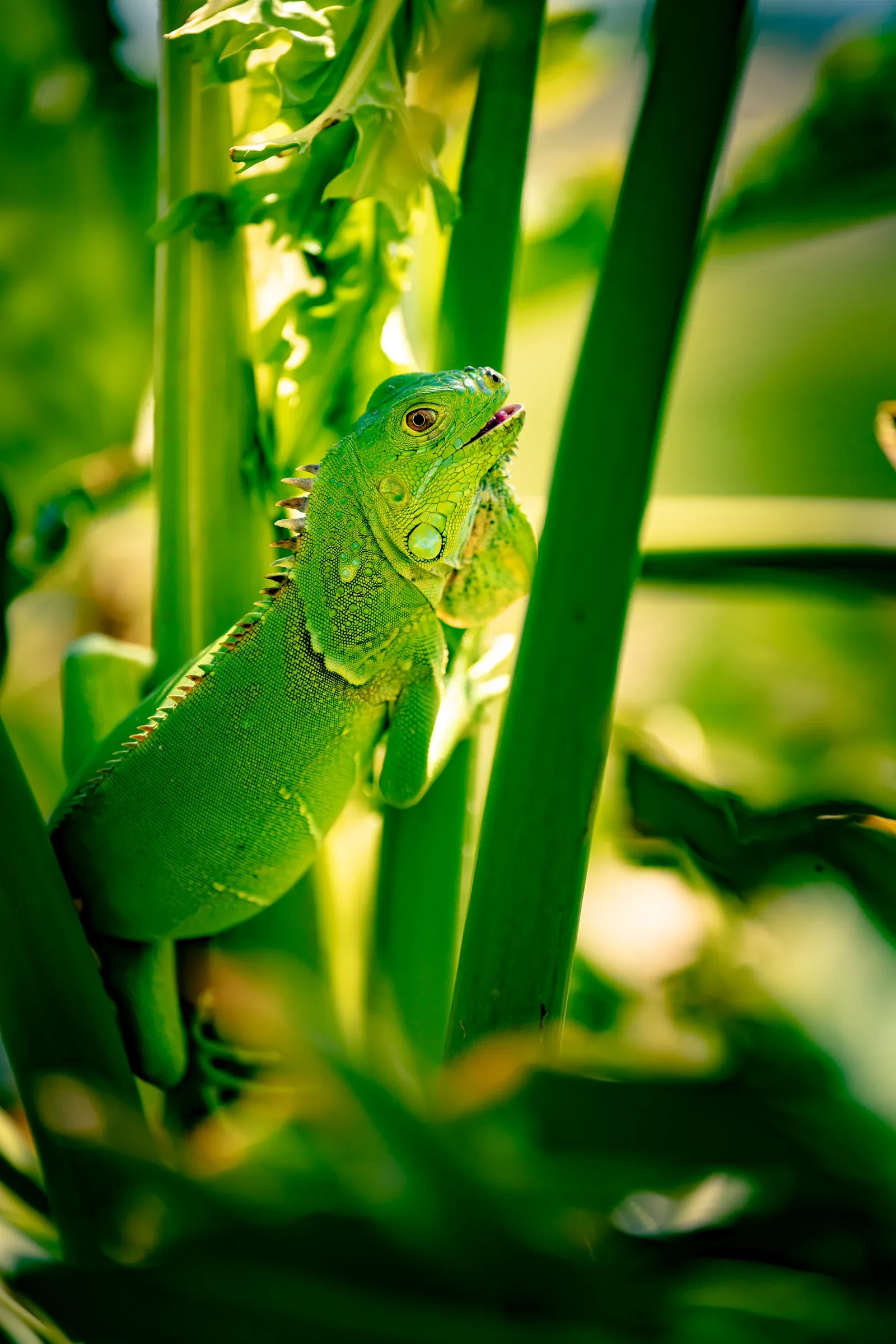
In the first, the iguana climbs up between tall green stems. Its body is a vivid lime, almost the same shade as the plants. The light comes from behind and above, so the edges of its scales glow, and the round, pale patch below its ear stands out like a small disc. Its eye is a deep amber, ringed with green scales, and its mouth is slightly open, a hint of pink inside. A crest of spines runs down its back, catching the light in a row of tiny orange points. Stems frame it on both sides, and the foreground is a dark blur of leaves.
In the second, the iguana sits among palm fronds and broad leaves, looking out over its shoulder. This one is more mottled, green with touches of orange and brown along its crest and neck, and it's holding a bit of dry grass or plant fibre in its mouth. The foreground here is a wash of out-of-focus leaves, pale and luminous, so the iguana seems to peer out from behind a curtain of light.
What ties them together is the colour. Both frames are almost entirely green, from the deep shadows to the brightest highlights. The iguanas aren't separated from their surroundings by colour at all. They're separated by focus and light. That's the challenge, and the pleasure, of photographing them: you have to find the one sharp line of an eye or a crest inside a field of green.
I kept my distance and let the lens do the work. Iguanas tolerate people to a point, and a long lens means you can watch without changing their behaviour.
From the bag
#20: Sony A7R III · Sony FE 70-200mm F2.8 GM OSS II · 200mm · 1/1250s · f/2.8 · ISO 100
**#21: Sony A7R III · Sony FE 70-200mm F2.8 GM OSS II · 188mm · 1/1600s · f/2.8 · ISO 100** Both frames use the same approach: the 70-200mm near its longest focal length and wide open at f/2.8. At that combination, depth of field is very shallow, so the plants in front of and behind the iguana dissolve into soft shapes while its eye and head stay sharp. Bright light allowed fast shutter speeds at ISO 100, 1/1250s and 1/1600s, which freeze any movement and rule out shake at the long end. Focus went on the eye each time; with depth of field this thin, it's the only thing that has to be exactly right.