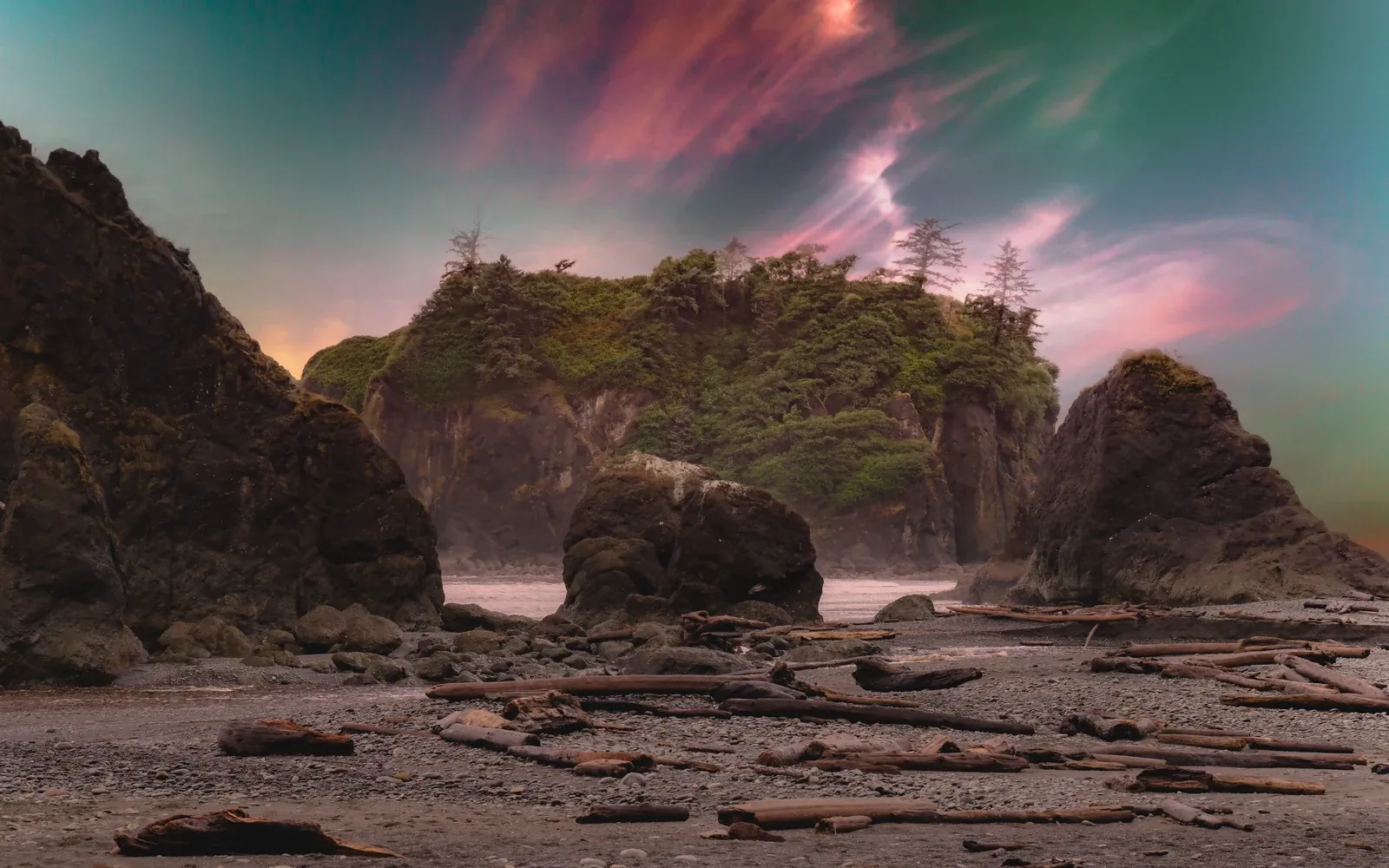
Ruby Beach, Washington
Where the Forest Walks Into the Sea
On the Washington coast, the trees don't stop at the shoreline, and neither does the story.
Driftwood is the first thing you have to negotiate at Ruby Beach. Not step around, but negotiate. Whole trees lie bleached and tangled along the top of the beach, stripped of bark and stacked by winter storms into piles you have to climb over to reach the sand. Some of them are bigger than my car. All of them came from somewhere upstream, a forest that let go of them and an ocean that sent them back.
It's a fitting welcome to a place where land and water don't have a clean border.
Out on the beach, the sea stacks rise from a floor of grey pebbles and dark sand. They aren't the bare rock towers you see in a lot of coastal photographs. These are crowned with forest: spruce and shrubs clinging to the tops, a few spindly trees standing up against the sky like they wandered out from the mainland and got stranded. The rock below is dark, streaked, and furred with green where the spray keeps it wet.
I spent a while walking before I took out the camera. Ruby Beach rewards that. The relationships between the stacks change with every few steps you take: one hides behind another, a gap opens up, a channel of water appears and disappears. I was looking for the moment where the big forested stack in the back sat squarely between the closer rocks, framed on both sides like a stage set, with a strip of bright water separating them.
When I found it, the sky had started doing something unexpected. Streaks of pink and rose were pulling across it at an angle, thin and fast-moving, over a blend of teal and green. It didn't look like a typical Pacific Northwest sky, which more often settles for a soft grey lid. This was louder. It made the dark stacks look even heavier underneath it.
I stayed put and let the scene arrange itself in front of me. A few logs lay in the foreground, half sunk into the gravel, leading the eye in toward the rocks. A boulder sat in the middle distance with a pale crust on top. The water behind it glowed faintly where it caught the sky.
There's a quietness to this kind of coast that I don't find in the desert, where I live. In Arizona, the land feels finished. Here, it feels like it's still being made. The stacks are pieces of headland the sea has already cut loose. The logs on the beach are trees the river has already given up. Everything in this frame is in the middle of becoming something else, just slowly enough that you can stand there and pretend it's holding still.
I made a handful of frames, then put the camera down and watched the pink fade. That part didn't need recording.
From the bag
Sony A7R III · Sony FE 70-200mm F2.8 GM OSS II · 70mm · 1/60s · f/9 · ISO 160
A telephoto lens is not the obvious choice for a beach, but it's my favourite tool at places like Ruby Beach. At 70mm, the shortest end of the 70-200mm, the lens compresses the distance between the sea stacks, so the forested rock in the background looks closer to the boulders in front of it. That stacks the layers together instead of spreading them out into a wide, empty scene. f/9 gave me enough depth of field to keep the driftwood, the boulders, and the background stack sharp together. 1/60s at 70mm is comfortable to handle with stabilization, and nudging ISO to 160 instead of base 100 kept the shutter speed there as the light faded, without any real cost in image quality on the A7R III.